The research first, then your own data.
Every grade starts with the human studies on an ingredient. Connect a wearable and HÉBÉ tracks what changes after you start each product.
Every grade comes from human studies.
A label tells you what's in the bottle. HÉBÉ tells you what the human studies found, for which outcome, and at what dose.
- studies analysed
- 7,984
- supplement labels on file
- 225,982
- brands recognised
- 13,251
- ingredients graded
- 507
7,984 unique studies sit behind the grades: the references cited in HÉBÉ's evidence catalogue plus the papers its evidence engine has read, each counted once. Among them are 5,027 meta-analyses, 778 systematic reviews, 273 randomised controlled trials and 12 other papers, 6 of them animal or lab studies. Studies indexed on PubMed. Labels from Health Canada's Licensed Natural Health Products Database and the NIH Dietary Supplement Label Database.
Five grades, and most claims don't earn the top one.
Only 4% of claims earn Excellent, and 42% of the outcomes tested found no effect. The app shows you both.
Half the question is whether you're taking enough to matter.
Every dose is compared with the amount the studies used, and with the safe upper limit.
See exactly how every score is madeIn the app · HÉBÉ+
The research, drawn, not listed.
Instead of a page of paper titles, each ingredient's evidence for your goal is one card you can read at a glance.
Excellent
Ashwagandha helps with stress in most studies
A dot per study · filled found a benefit · bigger had more people · ringed pooled many trials
Your stack against your goals
| Sleep | Stress | Focus | |
|---|---|---|---|
| Magnesium | |||
| Ashwagandha | |||
| L-theanine |
One look shows which goals your stack covers well, and which nothing is working on yet.
Members' reports, beside the research
For example: 7 in 10 members felt better with it
Anonymous, and only from members who chose to share. Shown as self-reports, never as research: people chose these products themselves and there's no comparison group.
Example cards. In the app they're built from HÉBÉ's research catalogue and your own stack.
Wearables · HÉBÉ+
Your body is the final study.
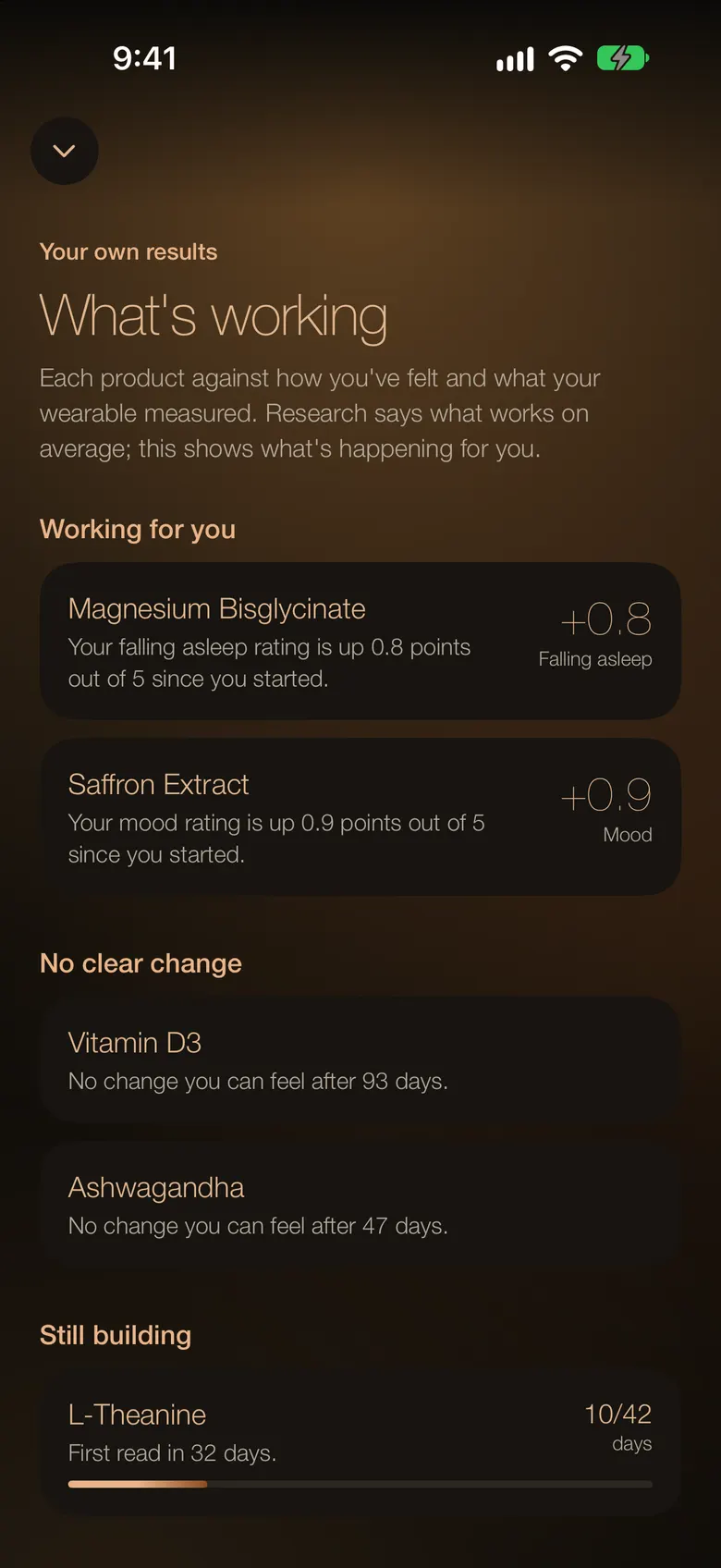
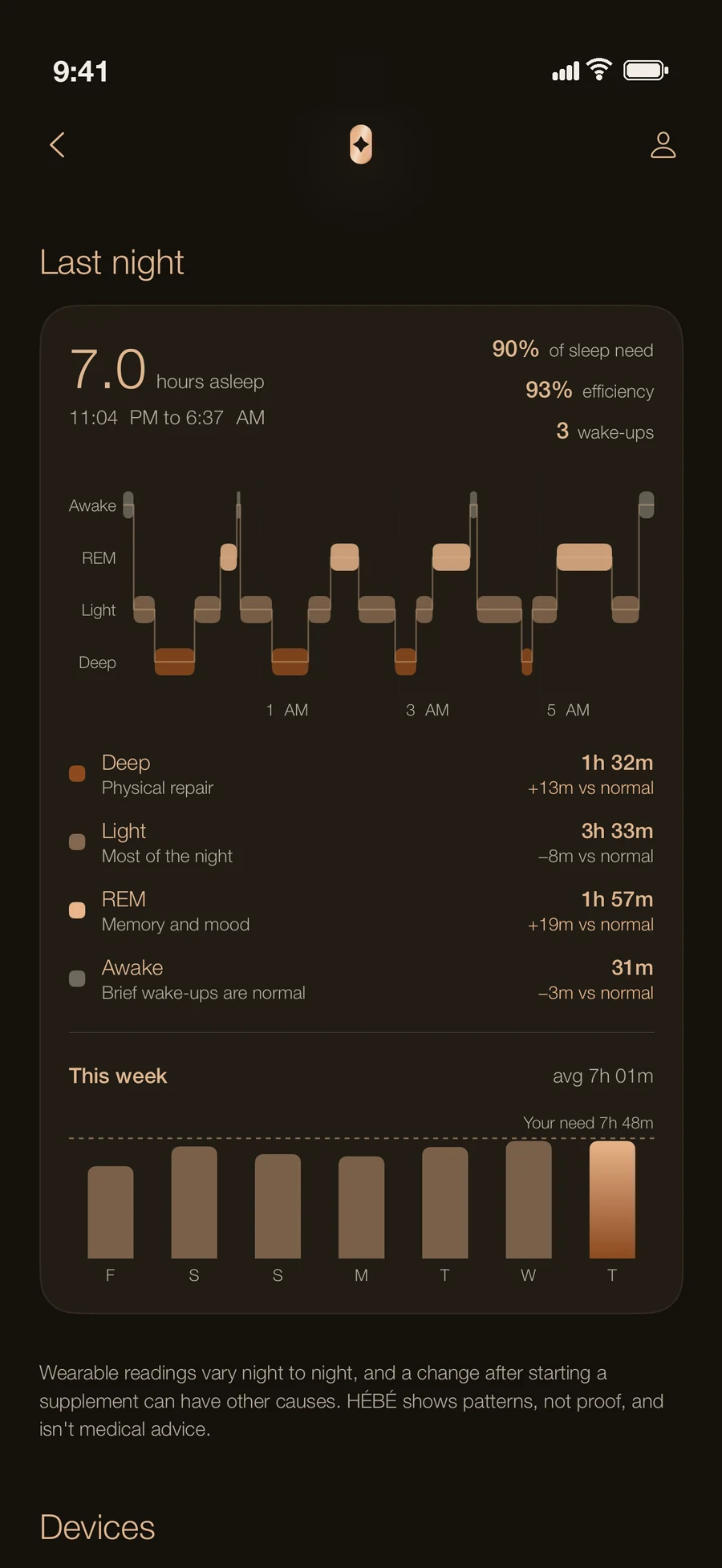
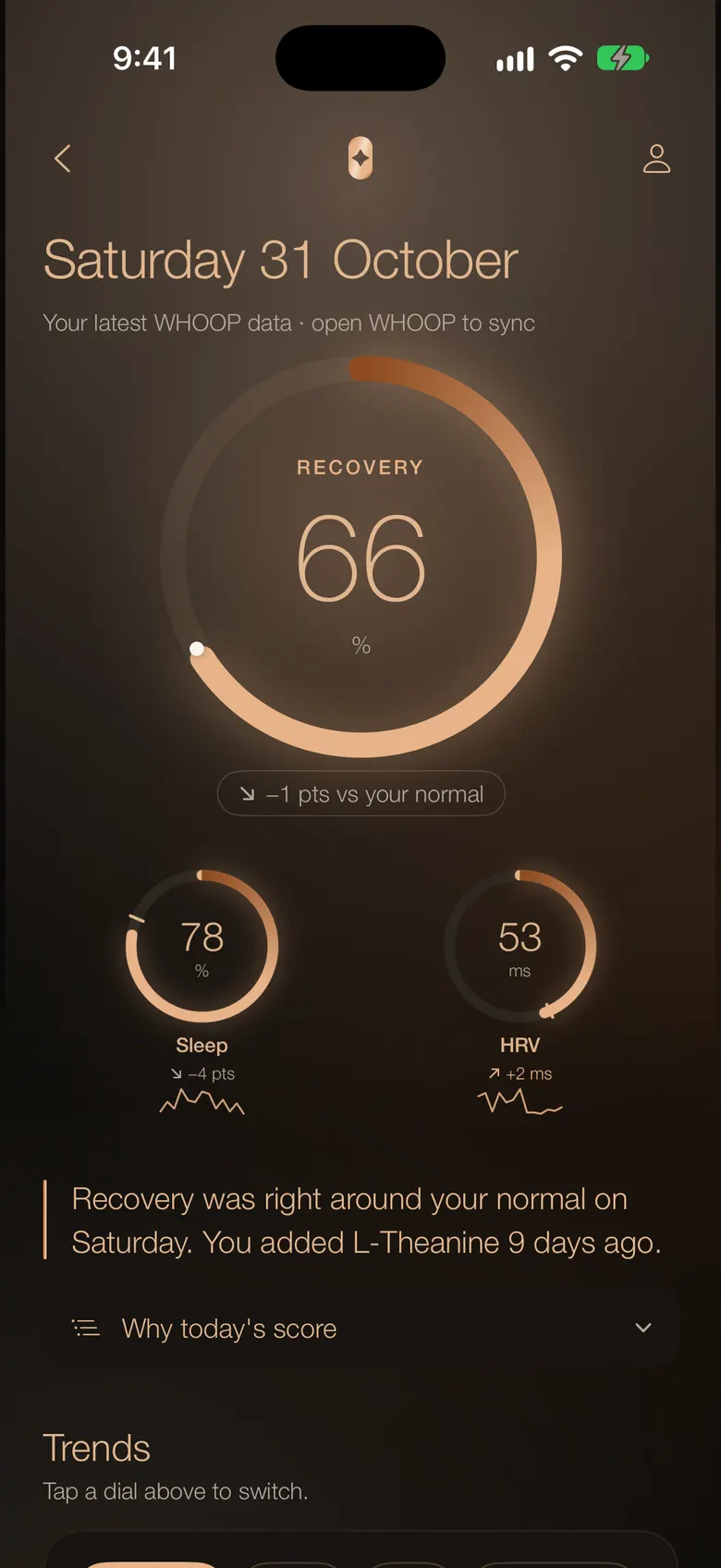
Studies tell you what works for most people. Your watch can show what changed after you started. Connect Apple Watch, WHOOP or Fitbit, and HÉBÉ checks whether your sleep and heart rate change after you start something new.
- Recovery, HRV, resting heart rate, sleep and breathing rate, against your own normal
- Every stack change marked on every chart
- Read together with your check-ins, so a product gets one verdict
- A verdict for each product, held to a 5% false-alarm rate
Calibrated on real data
Most apps call noise a result. We measured how often.
Your sleep and heart rate change every night anyway, so it's easy to think a supplement is working when it isn't. We tested this on real people's watch data, with 450 pretend start dates where nothing had actually changed. A simple before-and-after average finds a change most of the time. HÉBÉ's test, which accounts for your own night-to-night swings, almost never does.
How often each claims a change when there wasn't one
Time asleep
Resting heart rate
Sleep efficiency
17 people, 14 nights before and after each pretend start. Source: the public Fitbit Fitness Tracker dataset (2016). The 5% line is the standard false-alarm bar in clinical research.
Three honest answers, never a guess.
Clear change
The change is bigger than your usual ups and downs. Only then does HÉBÉ call it a clear change, and it still can’t rule out training, diet or stress.
Within your normal range
You’ve given it long enough, and nothing meaningful has changed. Worth rethinking.
Needs more nights
Too early to tell. HÉBÉ tells you how many more nights it needs to give you a fair answer.
How often a real effect of this size is caught
Sleep efficiency, +5 points
Shows within 3 weeks
76% after 2 weeks · 86% after 3 weeks
Resting heart rate, −3 bpm
Needs a few more weeks
41% after 2 weeks · 57% after 3 weeks
Time asleep, +30 minutes
Too noisy to judge in weeks
15% after 2 weeks · 23% after 3 weeks
The line marks 80%, the usual bar for a reliable test.
The right signal
Judged on what can actually move.
How long you sleep can swing by over an hour from one night to the next, which hides a supplement's effect for months. How well you sleep is much steadier, so a real change shows up within weeks. HÉBÉ judges each product on the signal that can answer the question, and tells you before you start how long a fair test will take.
HÉBÉ only reads your health data; it never writes to Apple Health or your device. Only daily summaries are synced, and you can disconnect at any time. Patterns in your data aren't proof that a product caused them, and none of this is medical advice. Phones show example data.
Check-ins and wearables
Your check-ins and your watch, read together.
Each product gets one verdict, built from up to three kinds of evidence. A finding only counts, for or against, once it clears the same 5% false-alarm test. No watch? Your check-ins carry it on their own.
01
Your check-ins, before and since
How you rated the goals a product is meant to help, in the weeks before you started it and the weeks since.
02
Days you took it, days you didn't
Your ratings on days you logged a dose, against days you skipped. The product is compared with itself.
03
Your watch, before and since
Sleep, HRV, resting heart rate and recovery against your own normal. It counts once you've logged at least half your doses.
Then one plain answer.
The verdict appears in What's working, part of HÉBÉ+. Your plan waits on it too: a step is settled by the watch test when a watch is connected, otherwise by your check-ins.
Check-ins also count toward your Stack Score. How you've rated the last 7 days makes up 19% of it, whether or not you have a watch. How the score works
Keep it
What clears the test leans your way, and nothing leans against it. That's how your days have gone, not proof it caused it.
Worth reconsidering
What clears the test leans against it, or a side effect showed up after you started.
Your call
No clear change after six weeks. Some benefits, like bones or heart health, never show up in how you feel, so weigh it against the research grade.
Log more doses
Too few days have a dose logged to read a fair before and after.
Start with your sleep supplements.
Scan the bottles you own. In a few minutes you'll know how well each one is dosed, whether they're safe together, and the one change worth making first. Then, month by month, you see what it did.
Coming soon to the App Store
See how it worksFor iPhone, with products sold in Canada and the US. Health data from Apple Health, WHOOP or Fitbit is read-only, and you can disconnect at any time. Educational information, not medical advice.